
Macon County Court Records Path
After a Macon County arrest, the first public question is often whether the person is in custody at the Macon County Detention Center. That answer comes from the Macon County Sheriff's Office, the sheriff app, the jail phone route, or a public-information request. The court question is different. Court records after a jail arrest answer what criminal case was filed, which charges moved forward, what hearings are set, and what disposition appears after plea, trial, dismissal, deferral, or other court action.
The local path runs from arrest and booking to first appearance and then to the North Carolina court record. Sheriff Brent Holbrooks and the Macon County Sheriff's Office operate the county detention channel, while the North Carolina Judicial Branch Macon County page, the clerk, and the NC eCourts Portal handle public case information. Booking charges may be a starting point. They are not the same as the filed court charges that the prosecutor and court process track.
Macon County Court Records Search
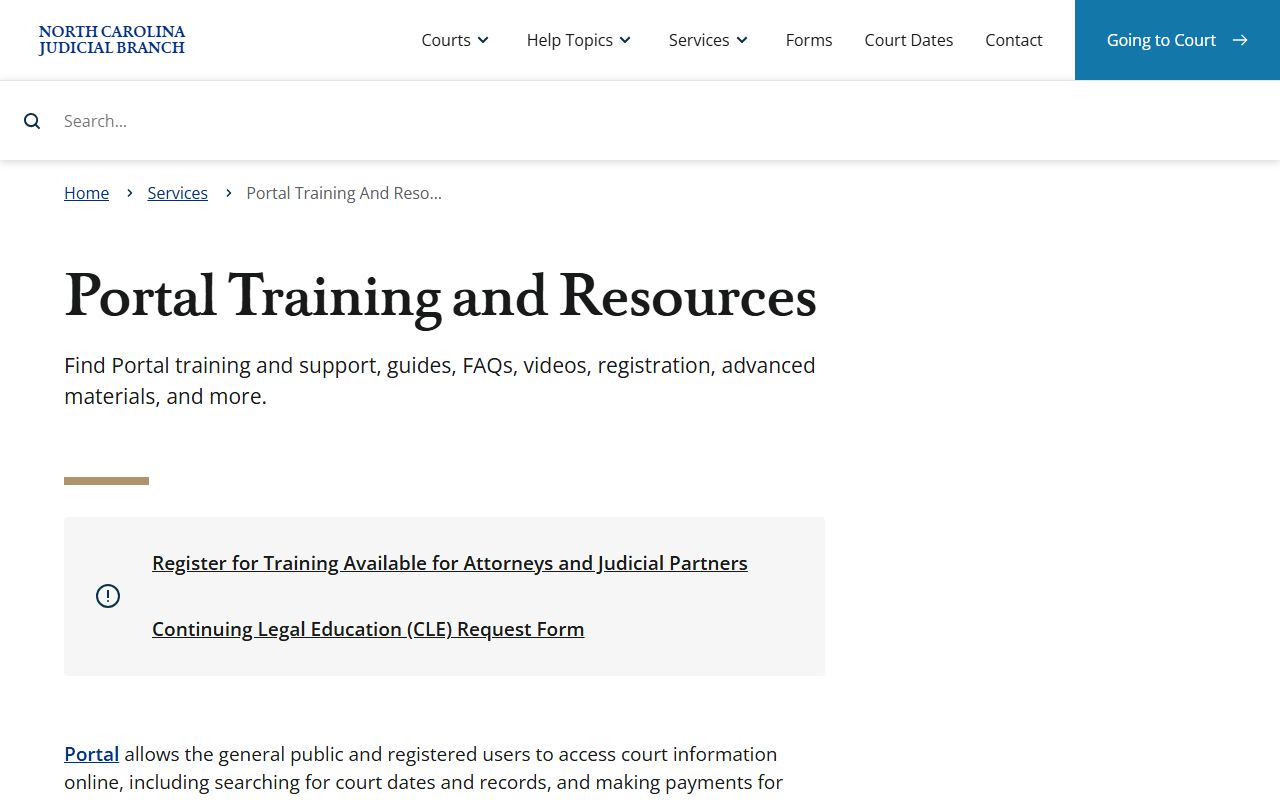
The strongest online starting point for Macon County court records after a jail arrest is eCourts Portal and Smart Search. The Judicial Branch training materials say public users can search case information, and the official training page describes filters for location, party name, date of birth, case type, case status, filing date range, hearings, attorney, judicial officer, courtroom, and case number. Public access does not mean every document is online. Some paper files still require the clerk's office, and some records are confidential or restricted by law.
The Judicial Branch eCourts training page shows the Smart Search and filter structure used for public case lookup.
Use Macon County or the correct court location when filtering, because District 43 includes several western North Carolina counties.
- Open eCourts Portal or use the court-date and case tools linked from the Judicial Branch Macon County pages.
- Search by defendant name first when the case number is not known. Add date of birth or filing filters when needed.
- Open the matching criminal case and compare each listed charge with any jail booking charge.
- Review case status, hearing dates, bond entries, disposition language, and judgment information where public.
- Use the clerk's office or a public terminal when the online result is incomplete or when a paper file is needed.
For custody or booking status, use Macon County jail inmate records. For booking photos, use Macon County jail roster mugshots. Court records after arrest should not be treated as a live jail roster.
Macon County eCourts Fields
Smart Search works best when the user understands which field answers which question. A name search can find a party. A hearing search can show current court events. A case-status filter can narrow active and closed matters. Macon County court records after an arrest may also be searched at a public terminal in a clerk's office by defendant name, case number, or victim and witness name, according to North Carolina court-record guidance.
| Field | Use | Notes |
|---|---|---|
| Smart Search | Broad public case lookup | Use defendant name or known case details. |
| Location | County or court filter | Select Macon County when available. |
| Party Name / DOB | Person search | DOB helps separate common names. |
| Case Type / Status | Criminal case sorting | Useful for pending, disposed, or restricted-result checks. |
| Filing Date Range | Date narrowing | Use approximate arrest or first court date. |
| Hearing Search | Court-date lookup | Can search by party, attorney, courtroom, or judicial officer. |
| Case Number | Exact case lookup | Judicial Branch examples use year, case type letters, sequence, and county identifier. |
| Wildcard | Partial-name or number search | Training materials describe minimum characters followed by an asterisk. |
Macon County Courthouse Records
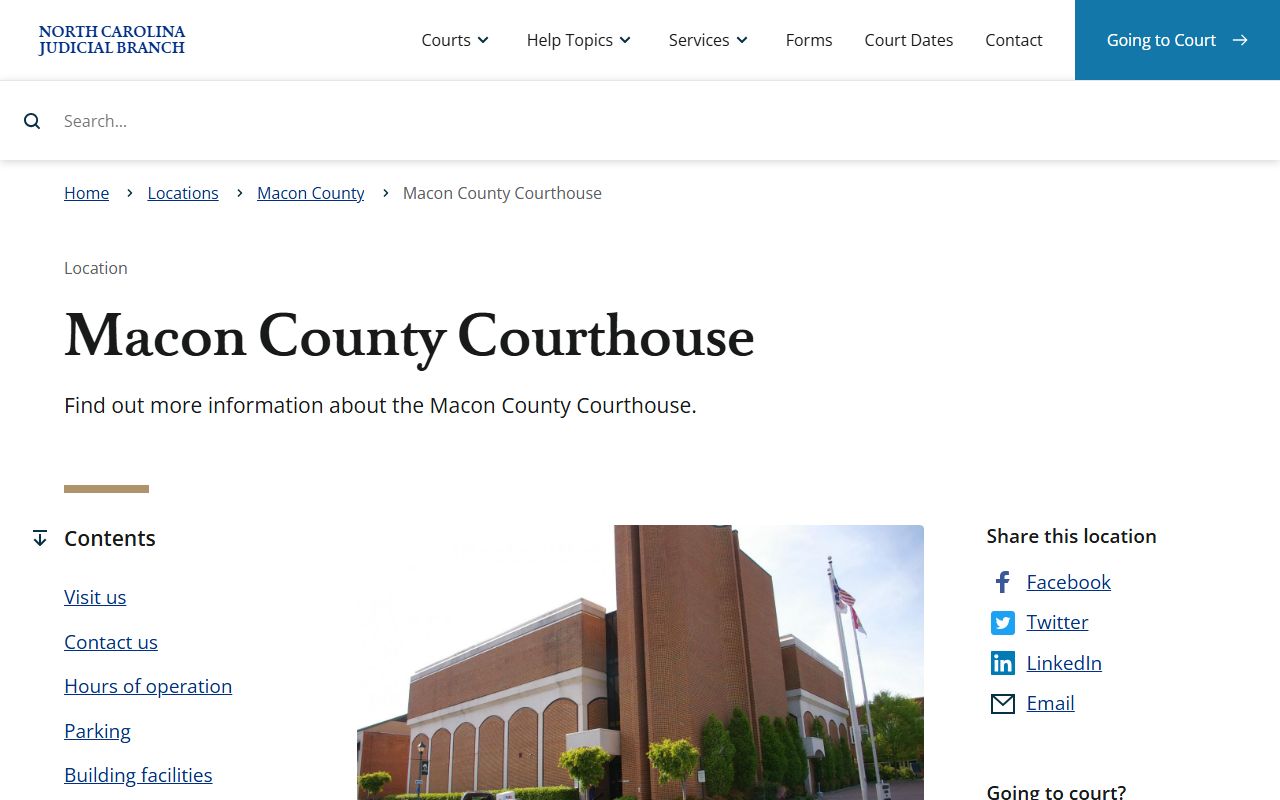
The Macon County Courthouse page lists the courthouse at 5 West Main Street in Franklin, with court access, parking, wheelchair access, and court-date links. The local Macon County Clerk page also points residents to court calendars, forms, rules, and general court-system information. The courthouse is separate from the Lakeside Drive detention center, so a person seeking paper court files should not go to the jail expecting the clerk's case file.
The North Carolina Judicial Branch says criminal and civil court records can be searched at public terminals, and paper files may be reviewed at the clerk's office in the county where the case is located. Copies may involve a fee. If the goal is a police report, jail booking sheet, or investigative file, the request may belong with MCSO or another law-enforcement agency rather than the clerk.
The official courthouse page is a useful source for confirming where Macon County court records are handled before making an in-person trip.
That distinction matters because Macon County detention records, court records, and prosecutor records are held by different offices.
Macon County Arrest Charges
Jail booking charges are the charges listed at intake after an arrest. Filed charges are the charges that appear in the court case. In North Carolina, the path may involve a magistrate, a citation or other criminal process, a prosecutor-filed document, or an indictment depending on the offense and case posture. Prosecutors may amend, reduce, dismiss, or replace charges, so court records after a jail arrest should be read as a case history rather than a single intake snapshot.
| Complaint or Process | Information | Indictment | |
|---|---|---|---|
| Typical source | Law enforcement, magistrate, or charging process | Prosecutor | Grand jury |
| Common use | Starts many criminal matters after arrest | Used when prosecution proceeds by filed accusation | Used for serious felony prosecution or superseding charges |
| What to compare | Booking charge and first case entry | Formal charge pursued in court | Charge language replacing or adding to earlier counts |
| Record caution | May change after first appearance | May be amended or dismissed | May supersede earlier court records |
Macon County District Attorney
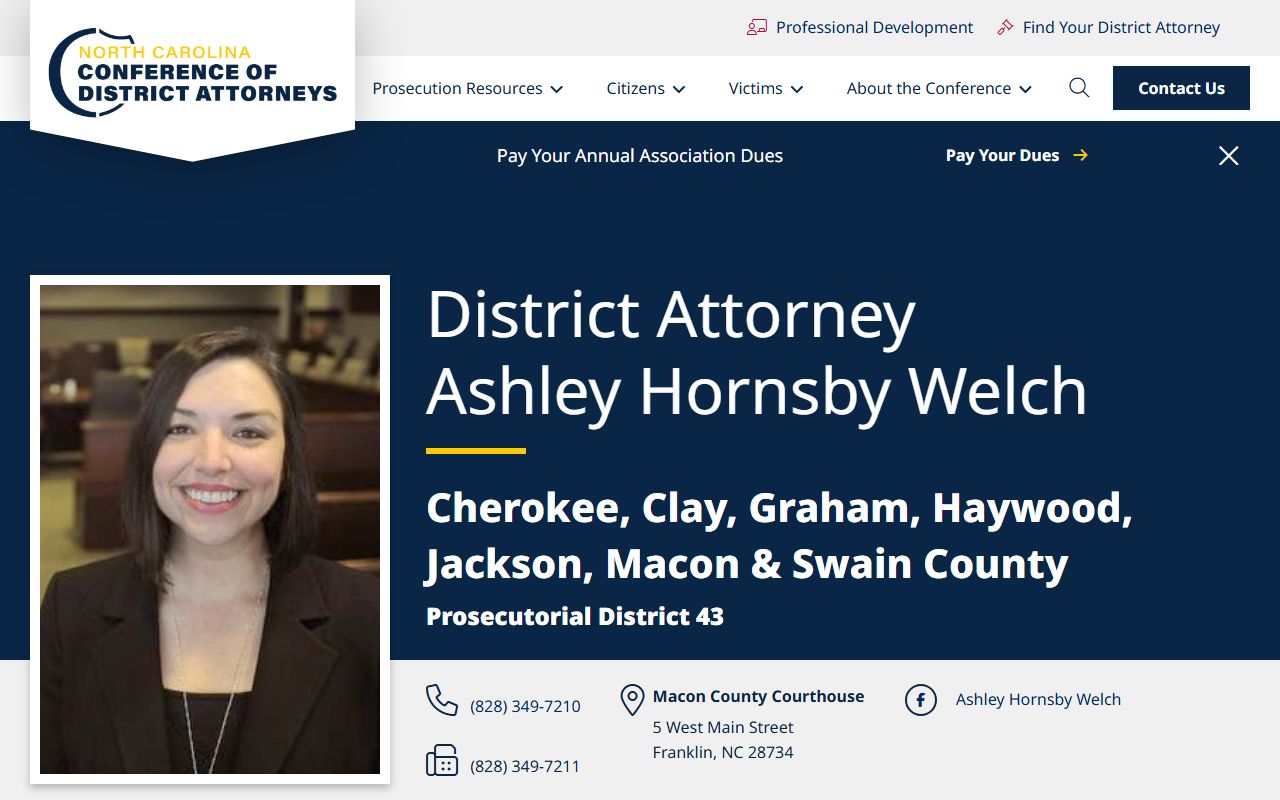
The prosecutor for Macon County is the District Attorney for Prosecutorial District 43. The official DA page identifies Ashley Hornsby Welch as the District Attorney and lists Cherokee, Clay, Graham, Haywood, Jackson, Macon, and Swain counties in the district. That regional structure can confuse people who expect a one-county prosecutor page, but it is the correct prosecution office for Macon County criminal cases.
The DA's role is the bridge between a jail arrest and the formal court record. The sheriff's office records custody and booking facts. The District Attorney represents the State in criminal cases, prepares the criminal trial docket, advises law-enforcement officers, and prosecutes criminal matters filed in the district. A Macon County arrest may start with one charge label at booking and later show a different status or charge language in court records once the DA and court process move forward.
The official District 43 page gives the prosecutor contact and explains why Macon County court records may refer to a regional office.
Victim notification needs may also involve NC SAVAN or VINELink, which NCDAC describes as a custody-status notification channel.
Macon County Charge Status
Charge status is the part of a Macon County court record that shows where the case stands. It can change more than once. A pending case can become dismissed, amended, reduced, superseded by indictment, convicted, deferred, disposed, or expunged. A booking record may still show the arrest charge that brought the person into jail, while the court record shows the legal path after filing.
| Status | Meaning in court records | Booking-record caution |
|---|---|---|
| Pending | The case or charge remains open. | Custody may change before the case ends. |
| Dismissed | The charge ended without conviction. | A past booking may still exist unless lawfully restricted or expunged. |
| Reduced or amended | The charge was changed by prosecutor or court action. | The jail intake charge may no longer match. |
| Superseding indictment | A later indictment replaces earlier charge language. | Compare case number and charge dates carefully. |
| Convicted | A conviction was entered by plea, verdict, or other final result. | Sentenced state custody moves to NCDAC, not the county jail roster. |
| Expunged | Eligible record removed from public access by order or statute. | Public lookup may no longer show the old case. |
Macon County Bond Records
Bond and release information after a Macon County arrest may sit in both jail and court channels. The jail can confirm current custody and release status. Court records can show scheduled appearances and filed case information. North Carolina release conditions may include a written promise to appear, custody release, unsecured bond, secured bond, cash bond, property or surety, or a no-bond hold. No official Macon County bond schedule was located, so any exact bond amount or payment method should be confirmed with the jail, magistrate, clerk, court, or approved surety.
| Release or hold type | How it works | What to verify |
|---|---|---|
| Written promise | Release based on a promise to appear. | Next court date and terms. |
| Unsecured bond | No money posted up front, but liability exists if the person fails to appear. | Amount and appearance terms. |
| Secured bond | Money, property, or surety is required before release. | Posting location and accepted method. |
| Cash bond | Cash is posted as security for release. | Whether cash is accepted and where to post. |
| Surety bond | A licensed bondsman posts bond for the defendant. | Do not rely on unofficial bondsman lists. |
| No-bond hold or detainer | Release is blocked until court or another agency acts. | Holding agency and next court action. |
Macon County Warrant Records
No official Macon County sheriff active-warrant search page was located on maconnc.org. The official sheriff app exists, but warrant-search fields were not verified from a desktop browser. For warrant concerns, use official channels: the Macon County Sheriff's Office, the Macon County Clerk of Superior Court, eCourts Portal, or legal counsel. MCSO public-information requests may be sent to mcsopio@maconnc.org, but active warrants may involve sensitive law-enforcement information.
An arrest warrant can lead to booking at the Macon County Detention Center. A bench warrant or order for arrest can follow a missed court date. A search warrant authorizes a search and does not automatically mean jail custody. A federal warrant may involve the U.S. Marshals Service for the Western District of North Carolina and may not appear in county public systems. If the person is already in jail, ask whether another hold or detainer affects release before assuming bond will clear custody.
Macon County Charges Compared
Charges and convictions should not be treated as the same thing. A charge is an accusation or filed criminal count. A conviction is a final adjudication by plea, verdict, or other legal result. Macon County court records after a jail arrest may show many steps between the two, and each step matters when reading the case.
| Charge | Conviction | |
|---|---|---|
| Stage | Accusation or filed count | Final adjudication or plea result |
| Proof level | Based on probable cause or prosecution filing | Requires proof, plea, or lawful finding |
| Record meaning | Shows what was alleged or pursued | Shows legal responsibility was entered |
| Outcome range | May be pending, amended, reduced, or dismissed | May lead to judgment, sentence, probation, jail, or prison |
Macon County Sealed Records
North Carolina uses the term expunction for many record-clearing procedures. A sealed or restricted record is hidden from ordinary public view but may remain available to certain courts, law-enforcement users, or agencies under defined rules. An expunged record is removed from public access by court order or statute when the case and person qualify. The exact effect depends on the statute, order, and record holder.
| Sealed or restricted | Expunged | |
|---|---|---|
| Public visibility | Not available to ordinary public users. | Removed from public access after a valid order or statute. |
| Record holder | May still retain limited internal access. | Must follow the expunction order and state law. |
| Common trigger | Confidential case type, juvenile matter, court order, or statutory limit. | Eligible dismissal, acquittal, conviction type, or other qualifying disposition. |
| Macon County route | Ask the clerk or court about access limits. | Use court expunction procedures and legal advice when needed. |
Chapter 15A expunction statutes and G.S. 15A-152 may affect criminal-history dissemination after expunction, but they do not create a simple self-help removal process for every arrest record or booking photo.
Macon County Record Limits
G.S. 132-1 defines public records broadly, subject to exceptions. G.S. 132-1.4 treats criminal-investigation and criminal-intelligence records differently from ordinary public records. That is why a Macon County court record may be public while police narratives, investigative notes, witness information, or some law-enforcement images are withheld. Court documents, jail records, and investigative files are not one single database.
Important: Public-record summaries are not consumer reports under the FCRA. Verify court outcomes with the clerk or originating office before relying on any record.